
Hisense 65E78QTUK PRO review: big screen or better picture?
Quick verdict
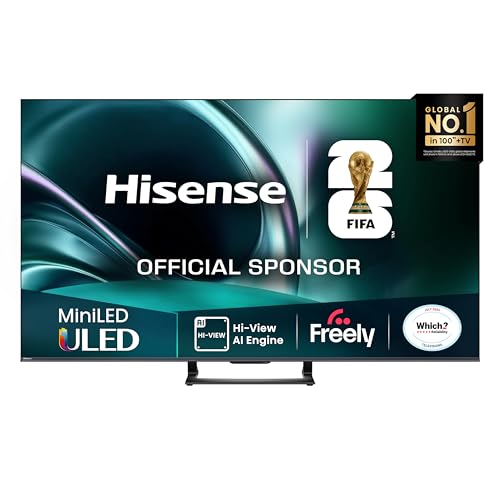
The Hisense 65E78QTUK PRO makes sense if you want a big living-room TV for PS5, football and Netflix without paying for a premium screen. Moving from 55 to 65 inches gives you about 40% more picture area, and this PRO version adds the high-refresh connections that cheaper 60Hz TVs often leave out.
Our verdict: a worthwhile shortlist for size and gaming when it costs clearly less than a 65-inch Mini LED. The catch is film picture quality: its backlight has no local dimming, so dark scenes and bright HDR highlights are where the saving shows. If the Hisense 65U7QTUK is close in price, its more capable backlight is the upgrade we would choose.
Bigger than 55 inches
High-refresh inputs
Film picture trade-off
| Screen size | 65 inches |
|---|---|
| Panel type | QLED LCD · direct-lit · no local dimming |
| Resolution | 4K · 3840 × 2160 |
| Refresh rate | 144Hz |
| Smart TV system | VIDAA · Freely |
| HDMI ports | 4 total · HDMI 3/4 for high-refresh gaming · eARC on HDMI 3 |
| Built-in sound | 2 × 10W speakers · Dolby Atmos support |
| Size with feet | 145.3W × 89.7H × 30D cm |
| Stand footprint | 99.4 × 30 cm · fixed feet |
| Wall mounting | VESA 400 × 300 mm |
Picture quality and gaming: what will you notice?
What will films actually look like?
QLED is about colour: the quantum-dot layer helps the TV show a wider range of shades. It is still an LCD screen with a backlight, rather than an OLED whose pixels light up individually. Colourful animation, daytime sport and bright game worlds suit its strengths.
The bigger limitation is no local dimming . The TV cannot turn down the lighting behind a dark part of the picture independently of a bright part. In a night scene with streetlights or white subtitles, blacks can look more grey and the bright details have less impact. This is the difference to pay for if you love watching films with the lights off.
Dolby Vision and HDR10+ let it read those HDR formats, but the logos do not guarantee dazzling highlights. Independent European E7Q PRO tests describe relatively restrained HDR brightness. A bright explosion or sunlight glinting off a car will have less punch than on a capable Mini LED.
What about a sunny room or seats to the side?
Reflections and off-centre viewing are weaknesses reported in E7Q PRO family testing. A window reflected in the screen can obscure darker scenes; colours and contrast also fade when viewed from the side. It is a more convincing choice opposite the sofa, with controllable daylight, than for a very bright room or a wide L-shaped seating arrangement.
Is it good for football, and does the AI help?
The large picture makes players and the ball easier to follow from the sofa. Motion smoothing can make camera pans look steadier, although strong settings can introduce artefacts around moving players. The 144Hz panel is useful hardware; it does not turn an ordinary broadcast into 144 different frames per second.
Hi-View AI Engine handles picture processing, including sharpening and upscaling lower-resolution video to fit the 4K screen. That helps with HD programmes, but a heavily compressed stream still looks softer than a good 4K feed. At 65 inches, those source-quality differences are easier to see.
What does 144Hz change on PS5 or Xbox?
PS5 and Xbox Series X use up to 120Hz; the full 144Hz is for a compatible PC. The useful console upgrade over a basic 60Hz TV is access to supported 120fps game modes. Those modes usually trade some image detail for smoother movement and quicker-feeling control.
It also helps beyond competitive games. In Marvel’s Spider-Man 2 on PS5 , a 120Hz display enables the 40fps Fidelity option: smoother camera movement than 30fps while retaining the more detailed graphics mode. The game is running at 40fps, even though the TV receives a 120Hz signal.
VRR keeps the screen in step with changing game frame rates to reduce tearing. ALLM automatically selects the low-latency game mode. Together, these are more useful reasons to buy the PRO than the AI label.
Where do the console and soundbar plug in?
Use HDMI 3 or 4 for high-refresh gaming. HDMI 3 also handles eARC, which sends TV audio to a compatible soundbar. With a soundbar on HDMI 3 and a PS5 on HDMI 4, HDMI 1 and 2 remain available for a Sky box or streaming stick.
That arrangement leaves only one high-refresh input free after adding an eARC soundbar. A household with both PS5 and Xbox cannot connect both directly at 120Hz while reserving HDMI 3 for sound; it would need a suitable HDMI switch or soundbar with compatible video passthrough.
Performance and experience
Living with it: size, apps and sound
How much room does a 65-inch screen need?
The jump from 55 inches adds roughly 40% more screen area. From a sofa around 2–2.7 metres away, 65 inches is a useful starting point: closer gives a more cinema-like view, while farther away is gentler for everyday television. That extra scale can be a bigger benefit than another feature badge.
The TV is 145.3cm wide and 89.7cm tall with its feet. The feet occupy 99.4 × 30cm and are not adjustable, so a narrow cabinet cannot be rescued by moving them inwards. For wall mounting, the fixing pattern is VESA 400 × 300mm.
Can it replace the aerial, and are the apps straightforward?
VIDAA includes Netflix, Disney+ and YouTube. Freely adds live channels from broadcasters such as BBC, ITV, Channel 4 and 5 over broadband, alongside on-demand programmes. For the main channels, that means television without an aerial cable across the room; an aerial can add channels outside the internet line-up.
VIDAA has its own app catalogue rather than Google TV’s. An existing Fire TV or other streaming device can still connect over HDMI, so changing television does not mean abandoning the interface or services you already use.
Will you need a soundbar?
The built-in system has two 10W speakers. It is a practical starting point for news, dialogue and casual viewing, but there is no dedicated subwoofer for the weight of explosions or music. Dolby Atmos support does not turn two TV speakers into a room full of surround speakers. For film nights, a soundbar with a subwoofer is a more meaningful upgrade than the Atmos badge alone.
Pros
- A 65-inch picture with a useful jump in size from 55 inches.
- 120Hz console support, 144Hz PC gaming, VRR and ALLM.
- Freely brings the main live channels over broadband.
Cons
- No local dimming: dark-film contrast and HDR impact are the main compromises.
- An eARC soundbar uses one of the two high-refresh HDMI inputs.
- Fixed feet need a support footprint of 99.4 × 30cm.
Community
User reviews
Owner feedback across the size range highlights easy setup and everyday picture and sound. That suits a simple living-room upgrade; it does not change the backlight limitations for film enthusiasts.
“Good picture quality and sound.”
“VERY easy to set up.”
Comparison
| Attribute | Hisense 65E78QTUK PRO Current | Hisense 65U7QTUK | Hisense 43E78QTUK PRO | Hisense 65E7KQTUK PRO |
|---|---|---|---|---|
| Price | Out of stock | Out of stock | £345.00 | Out of stock |
| Screen size | 65 inches | 65 inches | 43 Inches | 65 inches |
| Resolution | 4K · 3840 × 2160 | 4K | 4K | 4K |
| Refresh rate | 144Hz | 144Hz | 144Hz | 144Hz |
| HDMI ports | 4 total · HDMI 3/4 for high-refresh gaming · eARC on HDMI 3 | 4, including 2 Full HDMI 2.1 | - | - |
| Smart TV system | VIDAA · Freely | - | - | VIDAA U7 |
| Editorial score | - | 8.6/10 | 8.8/10 | 8.2/10 |
Hisense 65U7QTUK: the most useful comparison if you want to keep the 65-inch size. It adds Mini LED local dimming while retaining a 144Hz panel, plus a built-in subwoofer. The reason to spend more is better control of bright and dark areas in films, rather than a higher refresh-rate number. If the price gap is small, we would buy the U7Q.
TCL 55C6K-UK: a different trade-off if 55 inches is enough. Its Mini LED backlight provides local dimming, and it retains 144Hz gaming with Google TV. You give up about 28% of the Hisense’s screen area in exchange for a more capable backlight. For films from a shorter viewing distance, that can be a better use of the budget.
The E78Q PRO earns its place when the saving over a suitable 65-inch Mini LED is substantial and you would rather have the larger image. Similar prices weaken its case: QLED colour and 144Hz are available on TVs with better backlight control too.
Compare with Compare this model This product stays fixed; add a recommended alternative or search another model in the category.
Compare with
Add a second model to activate the direct comparison.
Recommended models



No products match that filter combination.
Is the Hisense 65E78QTUK PRO TV worth it?
The Hisense 65E78QTUK PRO is an appealing upgrade from a smaller, basic 60Hz TV: a much larger picture, useful PS5 and Xbox game modes, and Freely for everyday viewing. It suits a mixed-use living room where gaming and screen size matter more than cinema-style HDR. Its limits show most clearly in dark films, reflected daylight and seats well off to the side.
We would buy it at a clear saving over the 65U7QTUK. If those prices are close, the U7Q’s Mini LED backlight and subwoofer make the extra money easier to justify. If the E78Q PRO is the better offer, the 65-inch PRO listing on Amazon is the one covered here; the cheaper non-PRO version is a different buying proposition.
FAQ
Can I watch live TV without an aerial?
Yes. Freely streams the main BBC, ITV, Channel 4 and 5 channels over broadband. An aerial can add channels that are not included in the internet line-up.
Does this TV run PS5 games at 144fps?
No. PS5 output tops out at 120Hz, and only supported game modes run at 120fps. The TV’s 144Hz option is for a compatible PC; a 120Hz signal can also carry a 40fps game mode.
Sources and specifications
- Hisense UK: exact 65E78QTUK PRO specifications
- Tweakers: European 65-inch E7Q PRO picture, reflections and viewing angles
- Benchmark: independent European E7Q PRO picture and processing test
- PlayStation: PS5 4K and 120Hz output
- Game Informer: Spider-Man 2’s 40fps Fidelity mode on PS5
- Freely: watching live TV without an aerial
- RTINGS: screen size and viewing distance
- Hisense UK: 65U7QTUK Mini LED specifications
- TCL UK: 55C6K-UK Mini LED specifications
Review updated on