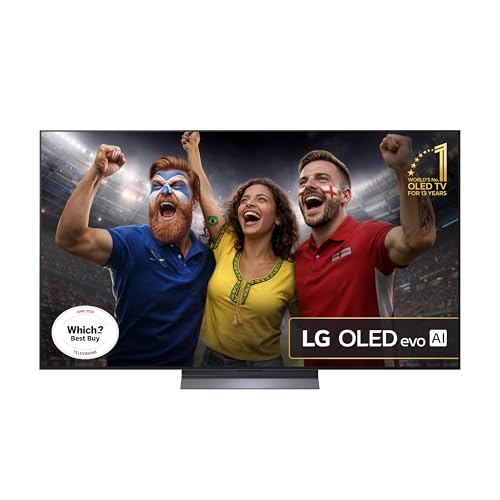
Televisions buying guide: how to choose the right TV for your budget and viewing habits
If football and daytime viewing matter, avoid cheap 60Hz sets and check for 4K, HLG support and solid reflection handling before anything else.
For most buyers, the fastest way to choose is this: prioritise a true 120Hz or 144Hz panel for sport, stronger anti-glare performance for bright rooms, and the right app and broadcast support for how you actually watch. OLED makes most sense if you want wide viewing angles and top contrast; Mini-LED is often the safer route for daytime brightness and bigger-screen value.
120Hz or 144Hz matters
Bright room vs dark room
Check UK app support
55-inch and up suits sport better
It is easy to get stuck between OLED and Mini-LED, premium and mid-range, or app features and picture quality. The real question is not which TV sounds best on paper, but which one fits your room, your viewing habits and the UK services you plan to use.
A TV that looks excellent in a dark demo scene can still disappoint once a football match starts in a bright living room. The two most practical reasons are motion persistence and bright full-screen behaviour.
1. Motion clarity
Why 120Hz is the real floor for sport-first buyers
Football constantly stresses horizontal pans and fast ball tracking. That is why the UK context in scope keeps warning against cheap 60Hz sets. Moving to a true 120Hz, 144Hz or 165Hz panel does not just help gaming specs on paper: it reduces visible blur and makes the action easier to follow when the camera sweeps across the pitch.
Standard 60Hz panel
More trailing and softer edges during long passes or quick camera pans.
120Hz to 165Hz panel
Cleaner tracking, less persistence blur and a safer baseline for football.
2. Daylight punch
Why Mini-LED often makes more sense in sunlit rooms
A football pitch is a bright, high-APL scene for long stretches, so dark-room contrast alone is not the whole story. This is where the reviewed Mini-LED sets, especially Samsung QN90F and Hisense U8Q, make practical sense: they are positioned around strong full-screen brightness and anti-glare control. OLED still wins on viewing angles and contrast, but bright-room football is where Mini-LED becomes the safer route.
Samsung QN90F Mini-LEDBright-room priority
High full-screen brightness and anti-glare behaviour are what make it a standout daytime football option.
TCL Q7C Mini-LEDValue daylight route
A strong value Mini-LED route if you want 144Hz sport performance without moving into flagship pricing.
Samsung S95F QD-OLEDPremium anti-glare OLED
The matte QD-OLED approach narrows the daylight gap, but it is still a premium OLED answer rather than the default bright-room value choice.
Typical OLED routeContrast-first route
OLED remains excellent for contrast and seating angles, but bright-room football is more panel-dependent unless glare control is exceptional.
Entry 60Hz LED routeWeak sport baseline
This is the route most likely to blur faster pans and look washed out once daylight and reflections hit the panel together.
These visuals are explanatory, not measurement charts. The hard recommendation logic still comes from the reviewed trade-offs in scope: avoid 60Hz for football, prioritise anti-glare and bright-room behaviour when daylight is a constraint, and treat OLED versus Mini-LED as a room-and-use decision rather than a prestige decision.
The S95F is the clearest premium football pick because it combines OLED contrast, a matte anti-glare screen and very strong motion handling. That mix matters when sport, daylight reflections and lower-resolution UK feeds all hit the TV at the same time.
The C5 is the easiest recommendation for buyers who want one TV to handle football, streaming and console use without leaning too hard into a single niche. It gives you OLED contrast, Dolby Vision and up to 144Hz VRR in a more balanced package than a pure sport-first flagship.
HDR format:Dolby Vision
Motion system:Up to 144Hz
Platform:webOS 25
Pros
Excellent balance for film, sport and gaming
Dolby Vision support
Wide viewing angles
Cons
Less convincing in very bright rooms than the strongest glare-focused rivals
The QN90F is the straightforward answer for daytime football in a sunlit room. When reflections and full-screen brightness matter more than absolute black depth, its Mini-LED brightness reserve is the cleaner fit than a standard OLED route.
The Q7C 75-inch earns its place because it protects the sport-first buyer from the most common budget mistake: chasing size and dropping to 60Hz. It still gives you 144Hz VRR, HDMI 2.1 and Dolby Vision IQ, which is why it remains the sensible big-screen value route.
HDR format:Dolby Vision IQ
Motion system:144Hz VRR
Platform:Google TV
Pros
144Hz Mini-LED value under flagship money
Dolby Vision IQ
Good feature depth for the price
Cons
Reflections are more visible
Viewing angles are weaker than on OLED
These rankings stay inside the reviewed model set in scope. They prioritise motion handling, bright-room behaviour, HDR support and viewing-angle trade-offs ahead of live pricing, which can change faster than the editorial fit of each model.
Which television type fits your room, viewing habits and budget
Bright living room with daytime sport
Brightness and reflection control matter more than perfect black levels.
Aim for 4K, HLG support and a true 120Hz or 144Hz panel. Cheap 60Hz sets are the wrong compromise here because fast ball movement and camera pans are where judder becomes obvious.
Samsung QN90F if bright-room performance is the priority; Samsung S95F if you want premium OLED contrast without giving up glare control.
Samsung QN90F, Samsung S95F
Mixed viewing: football, streaming and gaming
Balanced features beat a single headline strength.
Look for 4K, Dolby Vision if you want broader HDR support, and 120Hz or 144Hz for sport and gaming. The practical gain is smoother motion now and fewer compromises later.
LG C5 is the clearest fit because it combines OLED contrast, Dolby Vision and up to 144Hz VRR.
LG C5
Value-led big screen for sport
Do not let screen size push you down to a basic 60Hz panel.
At this end of the market, 144Hz support is the spec that protects sport viewing quality. It is more important than chasing marketing language around gaming if the panel itself is only 60Hz.
TCL C7K gives the stronger value route for buyers who want a large screen without losing motion capability.
TCL C7K
Need high brightness but want broader HDR support
Brightness and HDR format flexibility.
A set such as the Hisense U8Q pairs 165Hz with Dolby Vision and HDR10+, which is useful if you want strong daylight punch without giving up HDR format coverage.
Hisense U8Q suits buyers who want a bright, feature-rich alternative to more expensive flagships.
Hisense 65U8QTUK
Wide seating positions for family or friends
Viewing angles and motion consistency across the sofa.
Prioritise wide viewing angles and at least 120Hz. The practical benefit is that colour and contrast hold up better when not everyone is seated dead centre.
LG C5 for balanced use, or Samsung S95F if the room is also bright and reflective.
LG C5, Samsung S95F
The fastest way to avoid a bad TV purchase is to treat panel type as a room-and-use decision, not a prestige decision. If your room is bright, brightness and anti-glare can matter more than OLED black levels; if your seating is wide or film nights matter more, OLED's viewing-angle advantage becomes more valuable.
Television price snapshot versus review score
Review score
885.71.1k1.3k1.5k1.7k8.48.68.899.2
Hisense 65U8QTUK Mini-LED
TCL C7K Mini-LED
LG C5 OLED
Samsung QN90F Mini-LED
Samsung S95F OLED
Price snapshot in GBP
This chart is useful because the spread is not random. The two value-oriented Mini-LED models cluster just under the four-figure mark, with the TCL C7K at 8.5 and the Hisense U8Q at 8.4, which shows that you do not need flagship money to get 144Hz or 165Hz-class motion support and strong brightness. The LG C5 sits in the middle as a balanced step up: its 8.9 score comes with OLED contrast, Dolby Vision and 144Hz support, so the extra spend buys versatility rather than only marginal gains. The Samsung S95F reaches the highest score at 9.2, but the buyer consequence is clear: you are paying for a premium combination of OLED contrast, 165Hz motion and glare control, not simply for a small numerical uplift. Treat the prices here as source-time snapshots, not current deals.
OLED versus Mini-LED for UK television buyers
Bright-room viewing
Strong on premium models, but not equally strong across the board
Samsung S95F stands out because it pairs OLED contrast with a matte anti-glare screen, while LG C5 is less convincing in very bright rooms.
Usually the safer bet
Samsung QN90F and Hisense U8Q are positioned around high brightness, which matters for daytime sport and rooms with window glare.
Viewing angles
Best overall
Wide viewing angles are a repeated OLED advantage, which matters when several people are watching from the side.
More variable and often weaker
TCL C7K and Hisense U8Q both carry side-angle limitations compared with OLED.
Motion handling for sport
Excellent when paired with high refresh support
The reviewed OLEDs reach 144Hz and 165Hz, which is exactly the kind of spec that helps with fast ball tracking and camera pans.
Also strong in the better mid-range and premium sets
TCL C7K offers 144Hz, while Hisense U8Q reaches 165Hz, so Mini-LED does not automatically mean weaker sports performance.
HDR format flexibility
Depends on brand
LG C5 includes Dolby Vision, but Samsung S95F does not. Buyers who care about format coverage need to check the badge, not assume by panel type.
Mixed but often competitive
Hisense U8Q supports Dolby Vision and HDR10+, while Samsung QN90F does not support Dolby Vision.
Long static-logo use
Needs more care
LG C5 carries a burn-in warning under extreme continuous static use, which matters more for heavy news or channel-logo viewing than for mixed use.
Safer route
Samsung QN90F explicitly avoids burn-in risk, which can be reassuring for long sessions with persistent on-screen graphics.
Big-screen value
Usually pricier
You pay more to combine OLED contrast with high refresh rates and premium processing.
Better value path
TCL C7K and Hisense U8Q show why Mini-LED is often the easier route to a larger screen with 144Hz or 165Hz support.
There is no universal winner. OLED is the better route for wide seating and contrast-led viewing, while Mini-LED often makes more sense for bright rooms, longer static-logo use and stronger value at larger sizes. The practical tipping point is whether your room or your viewing habits create the bigger constraint.
Television buying mistakes and UK compatibility risks to avoid
Buying a cheap 60Hz TV for football
High
Start your shortlist at a true 100Hz, 120Hz or 144Hz panel instead of stretching screen size at the expense of motion quality.
Fast ball movement and camera pans are where 60Hz panels are most likely to show judder, blur or trailing. If sport is a priority, this is a visible downgrade rather than a minor spec-sheet issue.
Assuming every smart TV handles UK platforms the same way
High
Check whether you need built-in Freely or whether app-based access is enough for your setup before choosing a brand.
BBC iPlayer and ITVX support matter in practice, and Freely integration is not universal. The source context specifically notes that Freely is not currently integrated in Samsung or LG, even though their native BBC iPlayer and ITVX apps still work.
Importing a non-UK model to save money
High
Stick to UK-market models when local broadcast and streaming compatibility are part of the purchase decision.
Region locks can affect BBC iPlayer, ITVX and Freely access, and you may also run into UK plug and warranty issues. A cheaper import can become the wrong buy if core services or support do not line up.
Overlooking reflection handling in a bright room
Medium
If your room has windows opposite the TV, prioritise anti-glare performance and high brightness before chasing cinema-led specs.
A TV can look excellent in a dim demo but struggle when afternoon light hits the screen. This is why models such as Samsung S95F and QN90F stand out: glare control changes real-world usability, not just showroom appeal.
Assuming OLED and Mini-LED have identical long-term trade-offs
Medium
Match the panel type to your habits: OLED for contrast and angles, Mini-LED for bright-room resilience and heavier static-logo use.
OLED can bring burn-in risk under extreme continuous static use, while Mini-LED models avoid that specific concern but may give up viewing-angle performance or show some blooming.
High: Likely to affect day-to-day use or long-term satisfaction.
Medium: Important trade-off that depends on your room or habits.
Television buying FAQ for UK shoppers
Does 120Hz really matter for watching football?
Yes, if sport is one of your main reasons for buying a new TV. The key point from the evidence is that football exposes motion weaknesses quickly because of fast ball movement and constant camera panning. That is why the guidance repeatedly points to 100Hz, 120Hz or 144Hz panels and warns against cheap 60Hz sets. A 144Hz or 165Hz model such as the TCL C7K, Hisense U8Q or Samsung S95F is not only about gaming; it gives you a stronger motion baseline for sport too.
Is Dolby Vision essential when choosing a television?
Not always. It is important, but it should not override the rest of the buying decision. The clearest example is Samsung: both the S95F and QN90F skip Dolby Vision, yet they still make strong sense in scenarios where glare control, brightness and sport handling matter more. By contrast, the LG C5 and Hisense U8Q offer Dolby Vision, which gives them broader HDR format coverage. The practical rule is simple: if you mainly want the widest HDR support, keep Dolby Vision on the checklist; if your room is very bright, reflection handling may matter more.
What should UK buyers check for BBC, ITV and Freely support?
Check the exact platform path you plan to use, not just whether the TV is described as smart. The source context highlights BBC and ITV as the key broadcasters, with 4K UHD HLG support on BBC iPlayer and Freely. It also notes that Freely is not currently integrated in Samsung and LG, so buyers who want Freely built in should not assume every major brand handles it natively. DVB-T2, HEVC or H.265, and HLG support are the technical checkpoints worth verifying before purchase.
Is OLED or Mini-LED better for a bright room?
Mini-LED is usually the safer answer, but premium OLED can still work if glare control is unusually strong. Samsung QN90F is the straightforward bright-room recommendation because high full-screen brightness is one of its core strengths. Samsung S95F is the exception that proves the rule: it is an OLED, yet its matte anti-glare screen makes it more suitable for reflective rooms than many OLED rivals. If your room gets a lot of daylight, do not choose by panel label alone.
What screen size makes most sense for sport in the UK?
The source context specifically points buyers toward 55-inch and larger 4K sets for following the action more comfortably. That does not mean smaller TVs never work, but once you are buying mainly for football or big-event viewing, 55-inch is a sensible starting point. The more important warning is not to chase size by dropping down to a weaker 60Hz panel, because the motion compromise is easier to notice during sport than a small size difference.
Sources and editorial limits for this televisions guide
Sources and editorial limits for this televisions guide
This guide is based on a category-level UK source set covering television reviews, buyer-context notes for UK broadcasting and setup, and product-level strengths and trade-offs for the reviewed models named on this page.
UK television category scope and editorial constraints
UK broadcasting and setup context covering BBC, ITV, Freely, HLG, DVB-T2 and HEVC/H.265 considerations
Reviewed television entries for Samsung S95F, LG C5, Samsung QN90F, TCL C7K and Hisense 65U8QTUK
Evidence limits
Price references in the source material are snapshots, not live prices.
No original first-hand product evaluation is claimed.
Guidance is limited to the reviewed models and explicitly stated UK compatibility details.
2026-05-24T16:59:49Z
Cookie information
We use essential cookies and limited first-party measurement to operate and improve the site. We do not use third-party analytics or behavioural advertising in this configuration.